
Whether it’s mathematics or physics, understanding scalar and vector quantities is a very crucial part of studies. This understanding makes it possible for us to describe various physical phenomena we encounter in our daily lives.
Both these types of quantities seem similar at first, but there is a significant difference in terms of their characteristics and applications. If you are wondering what the difference between scalar and vector quantities is, this article is for you. So keep on reading…
What is a Scalar Quantity?
Any physical quantity that is described by its magnitude only, and no direction is needed in its description, is a scalar quantity. Such a quantity has a single numerical value and its unit, both collectively representing the magnitude.
As scalar quantities don’t have complexities of direction, they are easy to work with. Distance, speed, time, mass, energy, and temperature are all examples of scalar quantities.
For instance, if we say that this task takes only 30 seconds to complete or the temperature of this liquid is 35°C, we are here describing scalar quantities. That’s because we don’t need to specify any direction in their description.
What is a Vector Quantity?
If a quantity can’t be described just by specifying its magnitude, but its direction also needs to be specified, it is a vector quantity. So vector quantities, unlike scalar quantities, have both magnitude and direction.
Force, displacement, velocity, acceleration, and momentum are all examples of vector quantities. So if someone says that an object moves at 50 meters per second towards the west, it is complete information about the velocity of that object. And, the information will be incomplete if the direction is not specified.
Key Differences Between Scalar and Vector Quantities
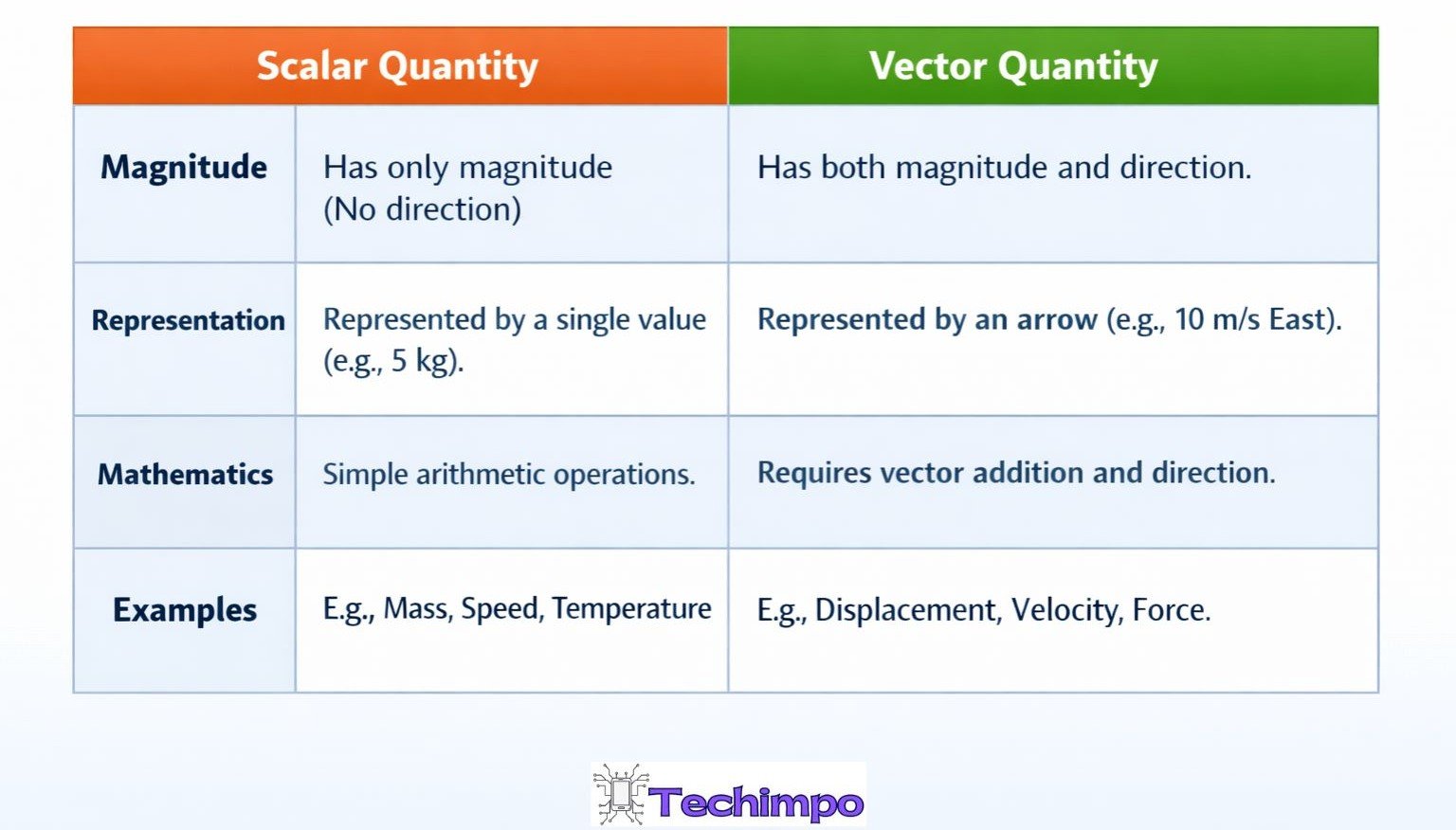
As mentioned above in this article, vector quantities, unlike scalar ones, also have directions. So this is the primary difference: scalars are described only by magnitude, whereas vectors require specifying directions as well.
Another difference between the two types of quantities lies in their representation. Numbers along with units represent scalars. Vector quantities, on the other hand, are represented by arrows in which the arrow length indicates the magnitude of the quantity, and the arrow’s direction indicates the direction of the quantity.
Moreover, in the case of scalars, it is possible to add, subtract, multiply, or divide the quantities with the use of simple arithmetic rules, whereas in the case of vectors, you will need some special methods for these operations on quantities. These special methods (like vector addition) take direction into account.
Real-Life Applications
If we closely look at our everyday life, we find extensive usage of both scalar and vector quantities. For instance, if you check your body temperature with the use of a thermometer, you are dealing with a scalar quantity (temperature). On the other hand, following directions on a map involves the application of vector concepts like direction, distance, etc.
In both science and engineering, vectors play a critical role in the analysis of forces, energy transfer, and motion. Scalar quantities, on the other hand, have their application in the measurement of temperature, work, and power.
Why Understanding the Difference is Important
If the difference between scalar and vector quantities is clear to you, it will lay a robust foundation for you in science. With this understanding in mind, you will be able to interpret physical situations in a better way and solve related problems accurately.
Conclusion
Both scalars and vectors are among the fundamental concepts in physics, one being specified by magnitude alone, while the other by both magnitude and direction. Understanding the difference between the two helps you better understand the physical world around you, thus enabling you to confidently apply scientific principles wherever needed.

Techimpo Editorial is the publishing desk of Techimpo, delivering comprehensive tech guides, tutorials, updates, and insights. Every article is rigorously reviewed and fact-checked before publishing.